
The UTPAL Method™
Teaching Children How to Think Through Chess
After more than two decades of coaching children, one observation appeared again and again.
Many students learned moves.
Many students memorized openings.
Many students solved puzzles.
But far fewer students were actually being taught how to think during a game.
The UTPAL Method™ was developed to address that gap.
It is not a chess system. It is not an opening repertoire. It is not a collection of tricks.
It is a structured thinking framework that uses chess as the learning environment to help children develop decision-making, planning, reflection, confidence, and independent problem-solving skills.
Why I Created the UTPAL Method
Over the years, I have worked with students of different ages, abilities, and experience levels.
Some improved quickly.
Others seemed stuck despite attending lessons regularly.
When I looked closely at their games, a consistent pattern emerged.
The problem was often not knowledge.
The problem was thinking.
Many students knew useful concepts. They had learned tactical patterns. They had studied openings. Yet they continued making avoidable mistakes.
They were often moving too quickly, overlooking information, reacting impulsively, or failing to evaluate consequences.
In other words, they were being taught chess concepts but not necessarily being taught a thinking process.
This observation became the foundation of the UTPAL Method.
Teach children how to think before teaching them what to think.
That idea became the foundation of the UTPAL Method™ and continues to guide every coaching session, assessment, and learning framework used today.
Learn more about my coaching background →
What Is the UTPAL Method?
The UTPAL Method™ is a structured thinking framework used during coaching sessions, game analysis, practice activities, and decision-making exercises.
It teaches students to move through five stages of thinking before, during, and after important decisions.
UTPAL Thinking Cycle
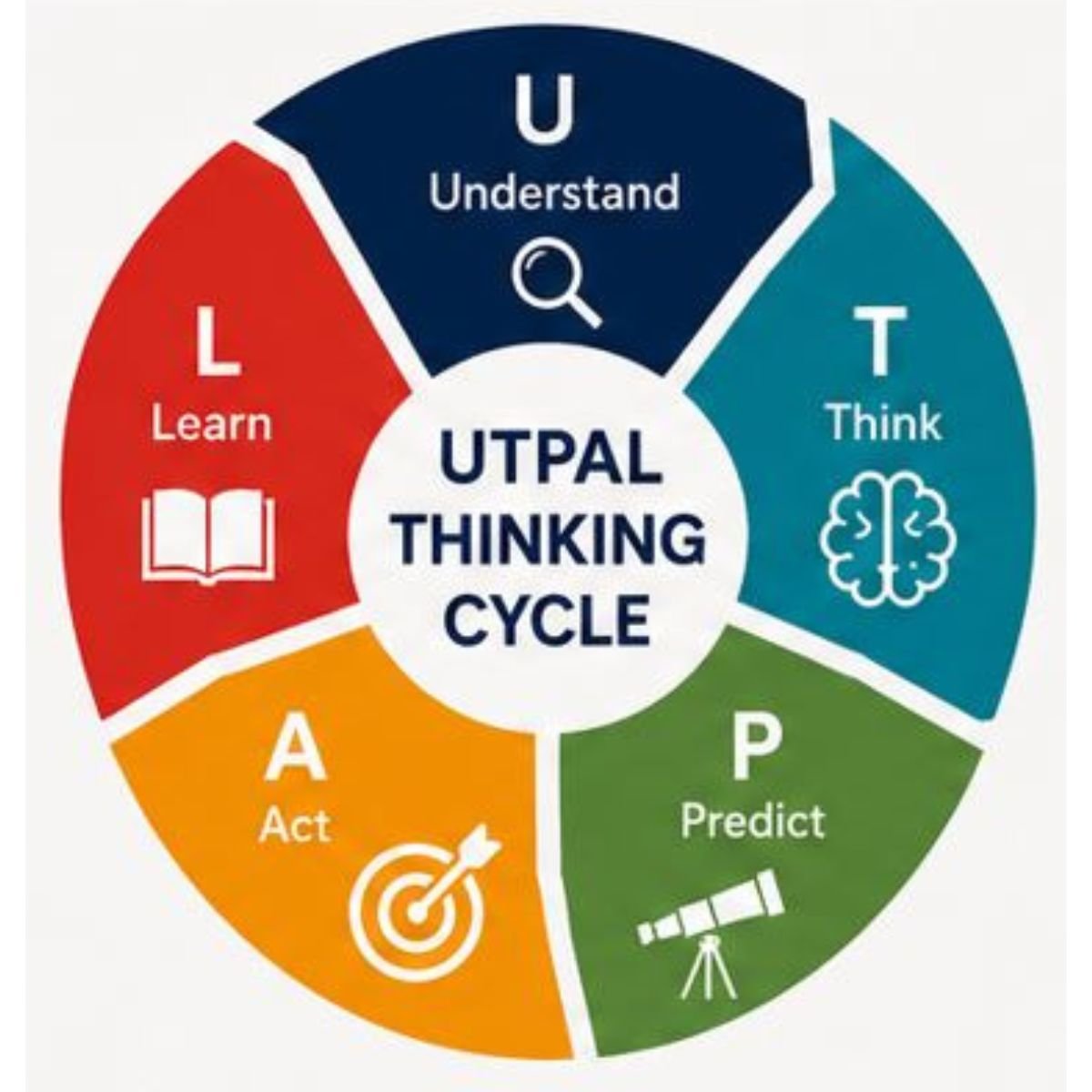
U — Understand
T — Think
P — Predict
A — Act
L — Learn
At first, students use the framework consciously.
With guided practice and repetition, many begin applying these habits naturally during games and increasingly in other areas that require careful decision-making.
What Makes the UTPAL Method Different?
The UTPAL Method™ is not an opening system, a memorization program, or a collection of chess tricks.
It is a structured thinking framework that teaches children how to understand situations, evaluate options, anticipate consequences, make decisions, and learn from experience.
Chess is the learning environment. Thinking is the skill being developed.
Why Use Chess to Teach Thinking?
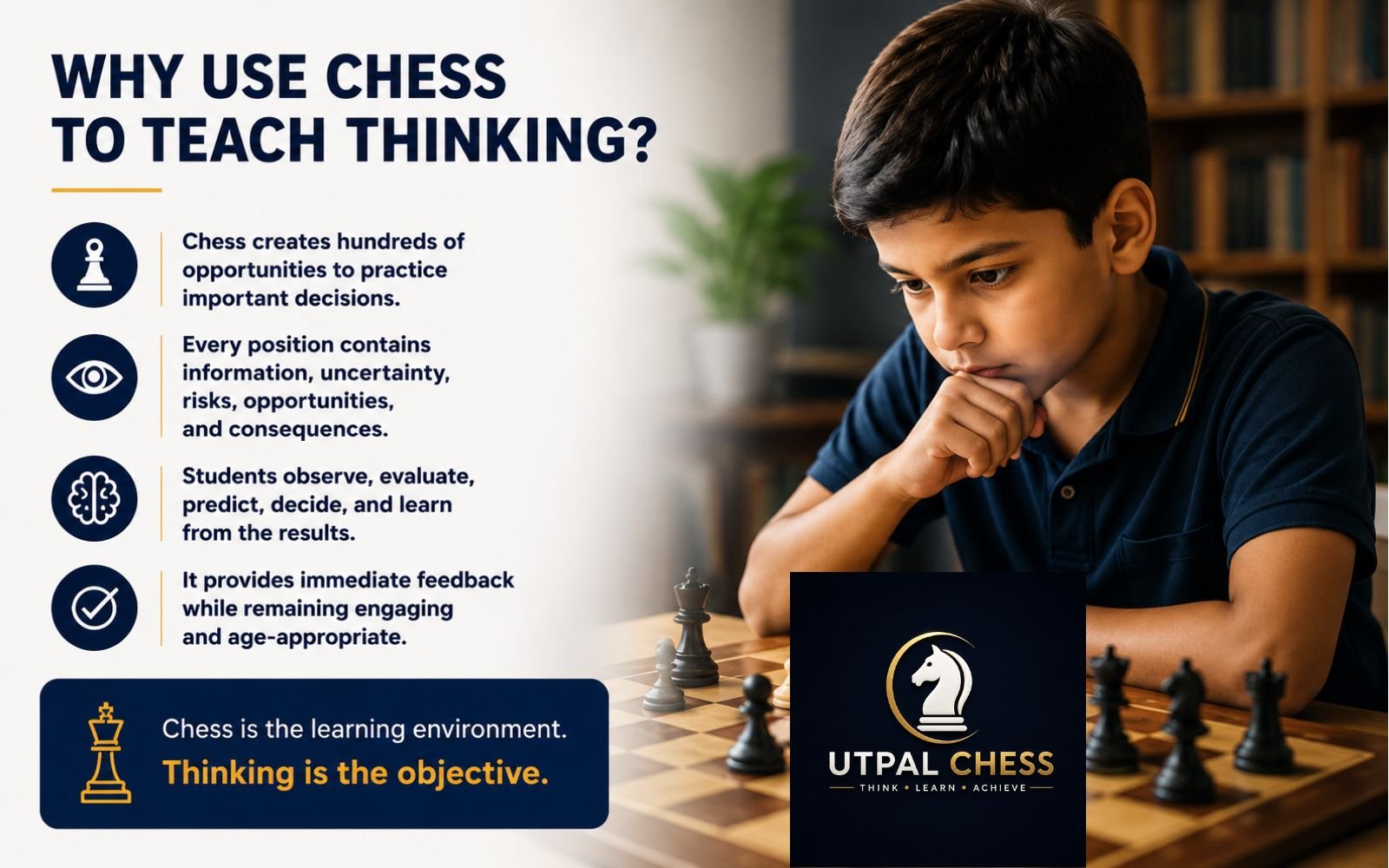
Children learn best when thinking is connected to meaningful decisions.
Chess creates hundreds of opportunities to practice those decisions in a structured environment.
Every position contains information, uncertainty, risks, opportunities, and consequences.
Students must observe carefully, evaluate options, predict outcomes, make decisions, and learn from the results.
Few activities provide such immediate feedback while remaining engaging and age-appropriate.
That is why the UTPAL Method™ uses chess as the learning environment.
Chess is not the objective.
Thinking is the objective.
Research has long explored the relationship between chess, problem-solving, and cognitive development in children. Learn more from FIDE.
The Five Stages of the UTPAL Method
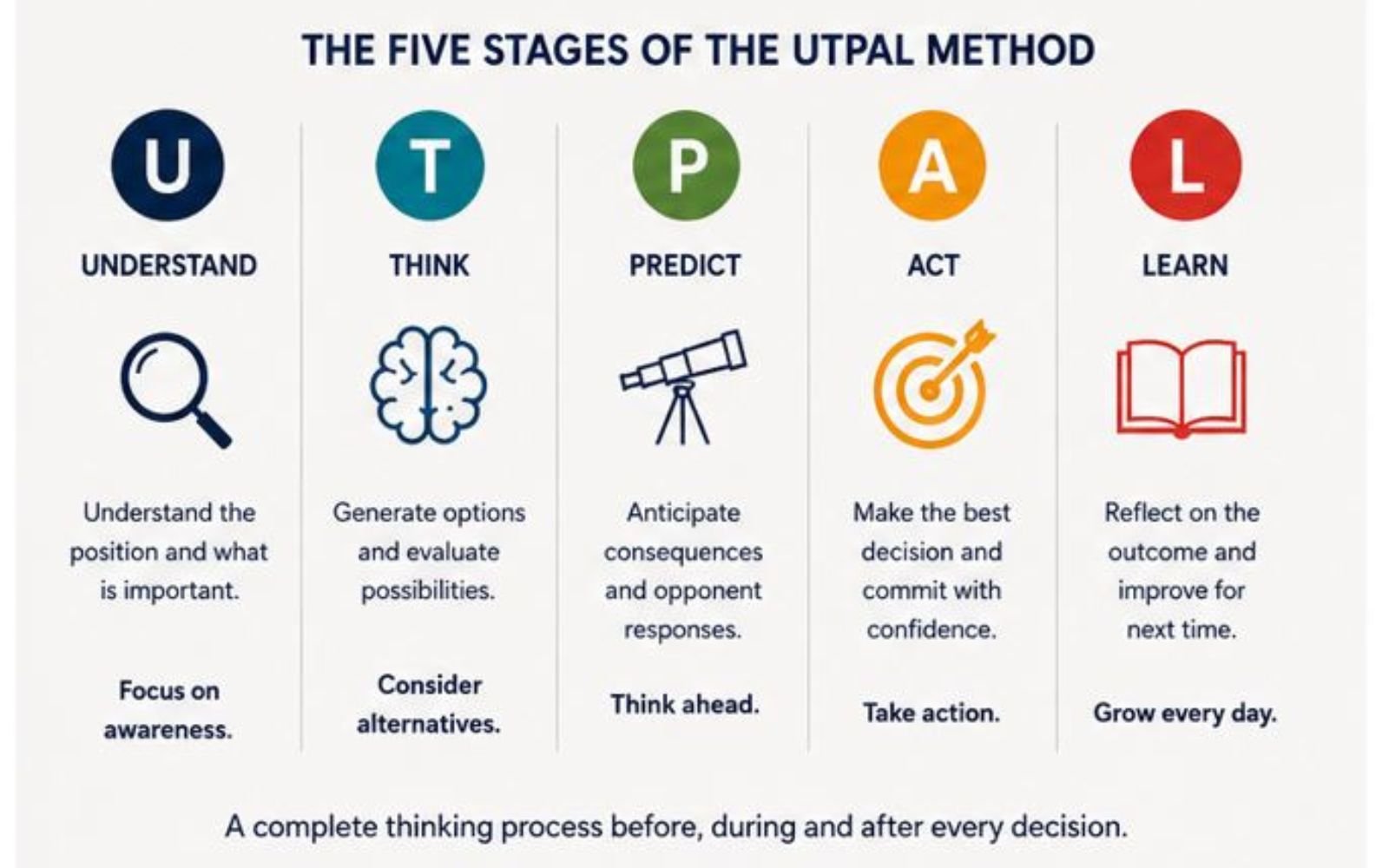
U — Understand
What It Means
Before making a decision, students learn to understand what is happening in the position.
Awareness comes before action.
Questions Students Learn to Ask
- What is happening here?
- What changed?
- What should I notice?
- What is important right now?
Thinking Skills Developed
- Observation
- Attention to detail
- Situational awareness
- Focus
Parent Benefits
Children begin slowing down and paying closer attention before acting.
T — Think
What It Means
Students learn that good decisions rarely come from considering only one option.
They are encouraged to generate alternatives and compare ideas.
Questions Students Learn to Ask
- What are my options?
- Which idea looks strongest?
- What are the advantages of each choice?
Thinking Skills Developed
- Reasoning
- Evaluation
- Comparison
- Flexibility
Parent Benefits
Children become less impulsive and more willing to consider multiple solutions before deciding.
P — Predict
What It Means
Students learn to think ahead and anticipate consequences.
This stage develops foresight.
Questions Students Learn to Ask
- What might happen next?
- How could my opponent respond?
- What risks should I consider?
Thinking Skills Developed
- Planning
- Cause-and-effect reasoning
- Risk awareness
- Strategic thinking
Parent Benefits
Children begin thinking beyond immediate actions and considering longer-term outcomes.
A — Act
What It Means
Eventually a decision must be made.
Students learn to commit to decisions with confidence while accepting responsibility for outcomes.
Questions Students Learn to Ask
- Which option am I choosing?
- Why am I choosing it?
- Am I ready to commit?
Thinking Skills Developed
- Decision-making
- Confidence
- Responsibility
- Ownership
Parent Benefits
Children often become more comfortable making decisions independently.
L — Learn
What It Means
Every experience becomes a learning opportunity.
Students are encouraged to reflect rather than simply move on.
Questions Students Learn to Ask
- What worked?
- What didn’t work?
- What should I do differently next time?
Thinking Skills Developed
- Reflection
- Self-awareness
- Growth mindset
- Continuous improvement
Parent Benefits
Children learn that mistakes are information, not failure.
How the Method Works in Real Coaching
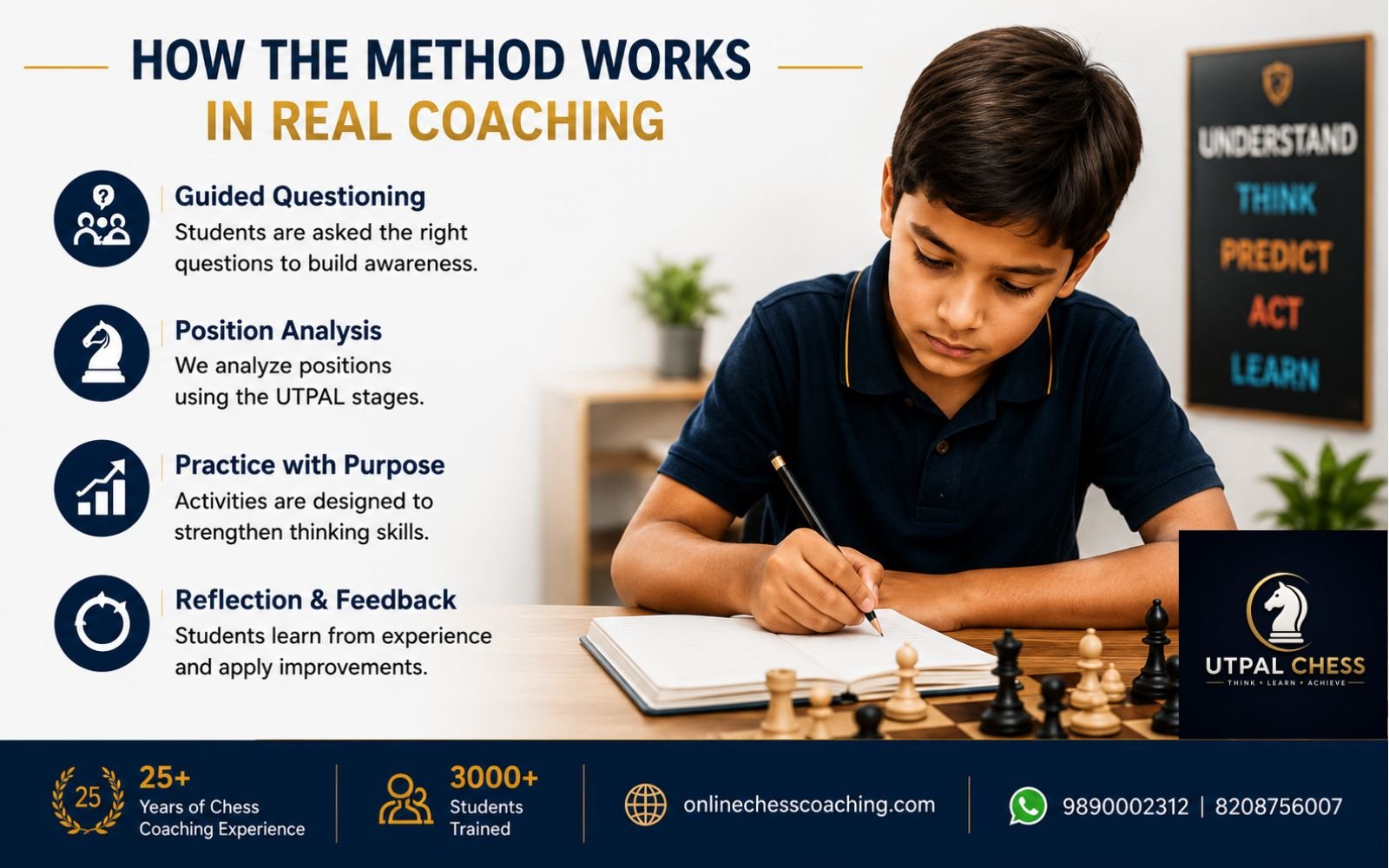
The UTPAL Method is woven into coaching sessions rather than taught as a separate subject.
Students are not simply given answers.
They are guided through a thinking process.
What Coaching Sessions Often Include
- Guided questioning
- Position analysis
- Decision-making exercises
- Reflection discussions
- Game review sessions
- Structured feedback
Instead of hearing:
“Play this move.”
Students are more likely to hear:
“What do you notice?”
“What options do you see?”
“What might happen if you choose that?”
This approach encourages active thinking rather than passive learning.
See how coaching sessions are structured →
Chess Skills vs Thinking Skills
| Chess Activity | Thinking Skill Developed |
|---|---|
| Tactical puzzles | Pattern recognition |
| Planning moves | Strategic thinking |
| Game analysis | Reflection and reasoning |
| Decision-making during games | Responsibility and judgment |
| Handling losses | Emotional resilience |
| Evaluating positions | Critical thinking |
| Comparing alternatives | Decision quality |
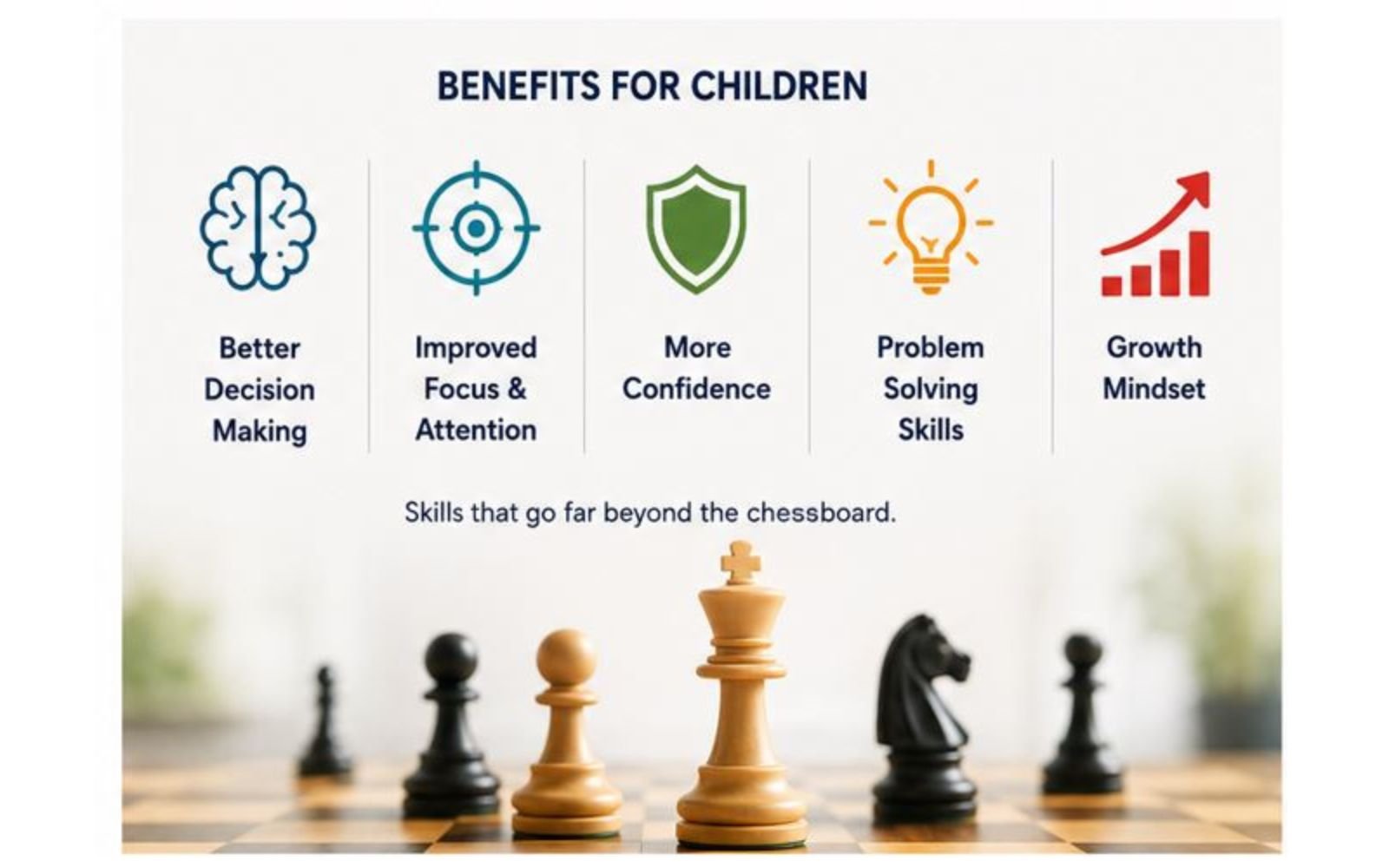
Benefits Parents Often Notice
- ✓ Better concentration during tasks
- ✓ Improved patience before acting
- ✓ Stronger decision-making habits
- ✓ Increased confidence when solving problems
- ✓ Better problem-solving approaches
- ✓ Healthier responses to mistakes
- ✓ Greater independence in learning
- ✓ More thoughtful thinking processes
Every child develops differently.
The goal is not to create identical students.
The goal is to help each child build stronger thinking habits through structured practice.
What Parents Often Observe Over Time
Every child develops differently, and no two learning journeys look exactly the same.
However, after working with students over many years, certain patterns appear repeatedly.
Parents often tell me that their children become more willing to pause before making decisions rather than rushing into them.
Many begin explaining their thinking more clearly.
Some become more comfortable tackling difficult problems without immediately asking for help.
Others develop a healthier response to mistakes because they learn to view mistakes as information rather than failure.
Improvement does not happen overnight.
But when children repeatedly practice observation, evaluation, prediction, decision-making, and reflection through chess, those habits often begin appearing in other areas of learning as well.
The exact changes vary from child to child.
The goal is not to create identical students.
The goal is to help each child become a stronger, more independent thinker.
Who This Method Is For
The UTPAL Method is particularly suitable for:
- Beginners learning chess for the first time
- Children who enjoy chess but feel stuck
- Students who need more structure in their learning
- Children who rush decisions and make avoidable mistakes
- Families seeking long-term developmental benefits
- Students who want to become more independent thinkers
The method adapts to the child’s current level while maintaining a consistent thinking framework.
Frequently Asked Questions
What age is suitable for the UTPAL Method?
The framework is commonly used with children aged 6–16. The way concepts are explained is adjusted according to age and experience.
Do children need tournament experience?
No. Many students begin with little or no tournament experience. The focus is on building strong thinking habits first.
Will this help academics?
The primary goal is chess-based thinking development. Many parents appreciate how skills such as concentration, planning, reflection, and problem-solving may support learning in other areas as well.
How long does improvement take?
Every child is different. Meaningful improvement depends on consistency, engagement, practice habits, and individual learning pace.
Is the method suitable for beginners?
Yes. In fact, beginners often benefit greatly because they develop structured thinking habits from the start rather than relying solely on memorization.
Help Your Child Learn How to Think Through Chess
Every child learns differently.
Some need more structure.
Some need greater confidence.
Some need better thinking habits.
Others simply need the right guidance at the right stage of development.
The purpose of an assessment is not to evaluate how much a child already knows.
It is to understand how the child currently thinks, learns, approaches decisions, and where the greatest opportunities for improvement may exist.
From there, a structured learning path can be created based on the child’s needs and goals.
If you would like to explore whether the UTPAL Method™ is the right fit for your child, the best place to begin is with an assessment or a conversation.